
Blog
8 Factors That Affect Your Truck's Appraised Value, Up or Down
The factors that affect your truck's appraised value go well beyond mileage: condition, maintenance records, upfitting, compliance status, and ownership history all move the number. This guide breaks down all 8 and gives owners a self-check framework to run before requesting a professional appraisal.
Two trucks can roll off the same assembly line, carry the same model year, and still appraise $20,000 apart. The gap almost never comes down to one thing. It comes down to a set of concrete, verifiable variables that a qualified appraiser weighs and documents, not a gut feeling about what the truck "should" be worth.
Our truck appraisal service walks owners, fleet managers, lenders, and attorneys through these variables on every engagement, whether the assignment covers a single day cab or a mixed fleet of forty units. This article breaks down the 8 factors that most often move a truck's appraised value, and gives you a self-check framework to run before you request a formal valuation.
What Actually Moves a Truck's Appraised Value?
A truck's appraised value is shaped by its remaining useful life, its documented history, its configuration, and its regulatory standing, not by a single number like mileage or age in isolation. Appraisers look at how these factors interact: a high-mileage truck with full maintenance records and a clean inspection history can appraise higher than a low-mileage truck with gaps in its paperwork and an unresolved out-of-service violation.
If you want the mechanics of how those factors get turned into a dollar figure (comparable sales, replacement cost, income approach), our guide on how truck fleet appraisers calculate value covers that separately. This article stays focused on the factors themselves: what appraisers are actually looking at when they walk around your truck, open the hood, and pull your file.
1. Mileage and Engine Hours
Odometer miles tell only part of the story. For vocational trucks, engine hours, PTO hours, and idle hours often matter more than road miles because they reflect how hard the engine and drivetrain have actually worked.
A truck with 400,000 miles of steady highway duty may have more remaining useful life than a truck with 180,000 miles that spent years idling at a job site or running stop-and-go refuse routes. Appraisers compare mileage and hours against the component's expected service life, not against an arbitrary age cutoff. A documented major-component replacement (engine, transmission, rear ends) can reset that clock and support a higher value even on an otherwise high-mileage unit.
2. Mechanical and Physical Condition
Condition is evaluated system by system, not as a single impression. Appraisers typically review engine performance and fault codes, transmission operation, differential and axle condition, brakes, tires, steering, suspension and wheel ends, frame integrity, and cab and interior condition.
Each deficiency gets priced as a specific repair cost deduction rather than a vague discount. A truck with a cracked frame rail or worn kingpins carries a different, more precise adjustment than one with cosmetic interior wear, even though both might look rough from the outside.
3. Maintenance Records and Component History
Documentation reduces uncertainty, and uncertainty is what appraisers discount against. Federal motor carrier rules require carriers to maintain inspection, repair, and maintenance records that identify the vehicle and document the date and nature of each repair. FMCSA guidance specifies that these records generally must be retained for one year at the location where the vehicle is housed, and for six months after the vehicle leaves the carrier's control.
A truck with oil analysis results, preventive maintenance logs, and itemized repair invoices is far easier to appraise confidently than an identical truck with no paper trail. When records are missing, appraisers often apply a conservative adjustment to account for the unknown condition of components that can't be verified.
Pro tip: Before requesting an appraisal, pull every service invoice, oil analysis report, and warranty claim you can find. A thin file almost always costs the owner value, even when the truck itself is mechanically sound.
4. Upfitting, Configuration, and Installed Equipment
Configuration changes the buyer pool, and the buyer pool changes the price. Day cab versus sleeper, axle configuration, wheelbase, fifth-wheel setup, and installed equipment like PTOs, wet kits, dump bodies, tanks, reefer units, or cranes all factor into the appraisal.
Specialized upfitting adds replacement cost, but it doesn't automatically add equivalent market value. A truck built out for a narrow application (say, a specialty tank body) can be worth less on the open market than its build cost would suggest, simply because fewer buyers need that exact configuration. Appraisers weigh installed equipment against how useful and desirable it is in the relevant market, not just what it cost to install.
5. Inspection and Compliance Status
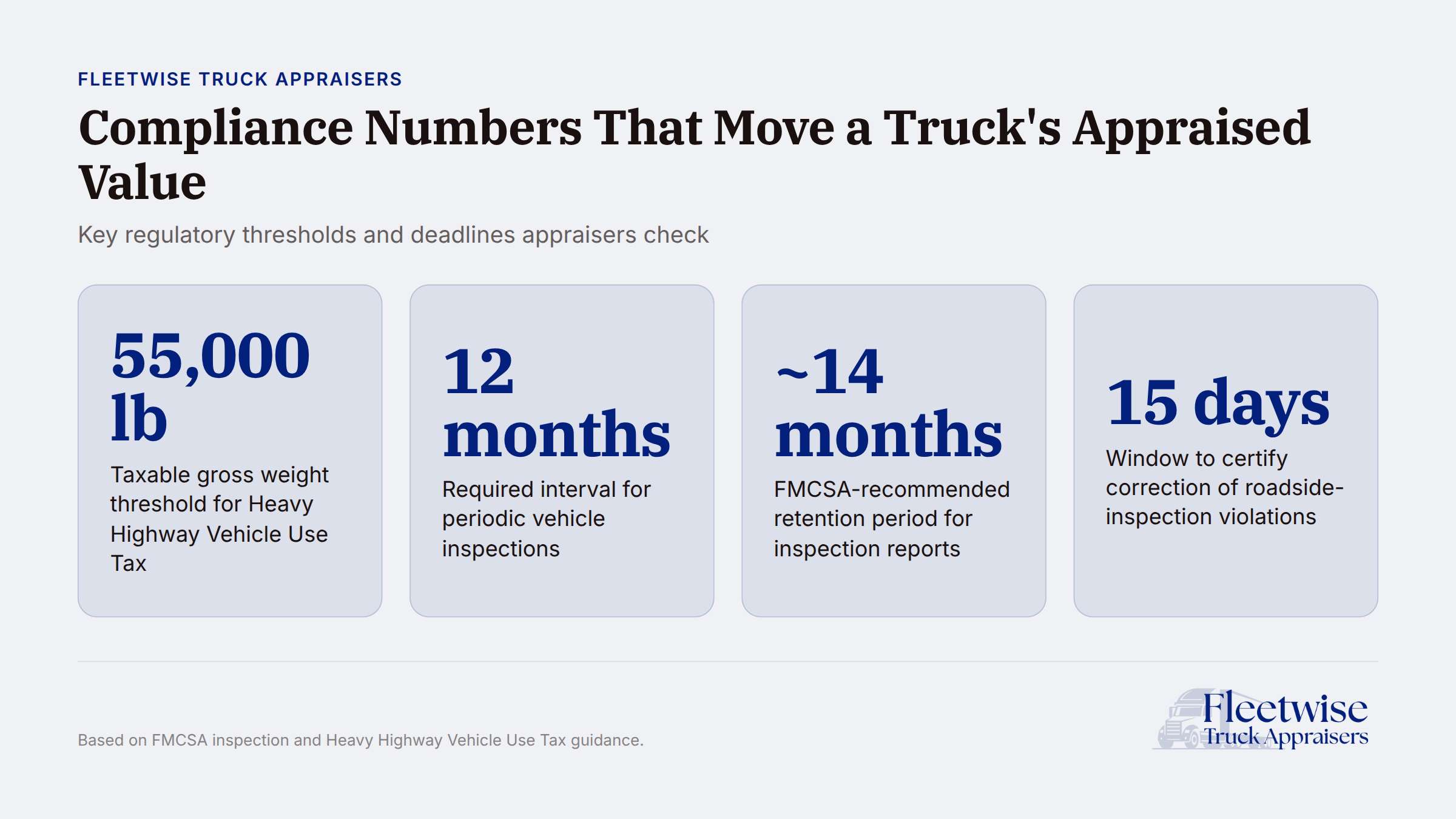
A truck's inspection history affects marketability even when the mechanical condition looks fine on the surface. Commercial vehicles generally require a periodic inspection at least every 12 months, and FMCSA guidance calls for that inspection report to be retained for roughly 14 months. Carriers must also certify that roadside-inspection violations have been corrected, typically within 15 days.
An out-of-service violation must be corrected before the vehicle can return to operation at all. Missing inspection paperwork, repeated violations, or an unresolved out-of-service event signals to a buyer (and to an appraiser) that there's hidden cost or downtime ahead, which pulls the appraised value down even if the truck runs.
6. Emissions Equipment and Regulatory Usability
Emissions configuration determines where and how a truck can legally operate, which directly affects its buyer pool and operating cost. Appraisers check the condition of diesel particulate filters, selective catalytic reduction components, exhaust gas recirculation systems, and related sensors as part of the mechanical review.
Gross weight also carries tax significance. The IRS requires the Heavy Highway Vehicle Use Tax for highway vehicles with a taxable gross weight of 55,000 pounds or more, and the IRS instructions for Form 2290 define that taxable weight as the fully equipped unloaded vehicle plus any qualifying trailers and the maximum customary load. That threshold doesn't set market value on its own, but it affects ongoing ownership cost, and appraisers account for it when comparing trucks rated differently or intended for different applications.
7. Utilization and Operating History
How a truck was used matters as much as how long it's been used. Long-haul highway service, construction, logging, refuse collection, quarry work, and heavy stop-and-go delivery each produce distinct wear patterns on the frame, suspension, and drivetrain.
Downtime history matters too. A truck that has spent significant time out of service for repairs or compliance issues carries a different risk profile than one with a consistent utilization record, even at the same mileage. Appraisers try to verify prior application through maintenance records, inspection reports, and consistent odometer or hour readings, since an inconsistent record is itself a warning sign.
8. Title, Accident, and Ownership History
Title branding, accident history, flood or fire exposure, liens, and gaps in the chain of ownership can meaningfully reduce value, sometimes more than any mechanical issue would. A rebuilt or salvage title narrows the pool of buyers and lenders willing to touch the truck, even after full repairs.
Odometer inconsistencies across service records or title transfers are a particular red flag. Appraisers cross-check mileage and hour readings against maintenance invoices and prior inspection reports to confirm the history is internally consistent before relying on it.
A Self-Check Framework Before You Request an Appraisal
Before you request a formal valuation, run through a short internal review. It won't replace a credentialed appraisal, but it will tell you where your documentation is strong and where it's thin, which affects how confidently an appraiser can support your number.
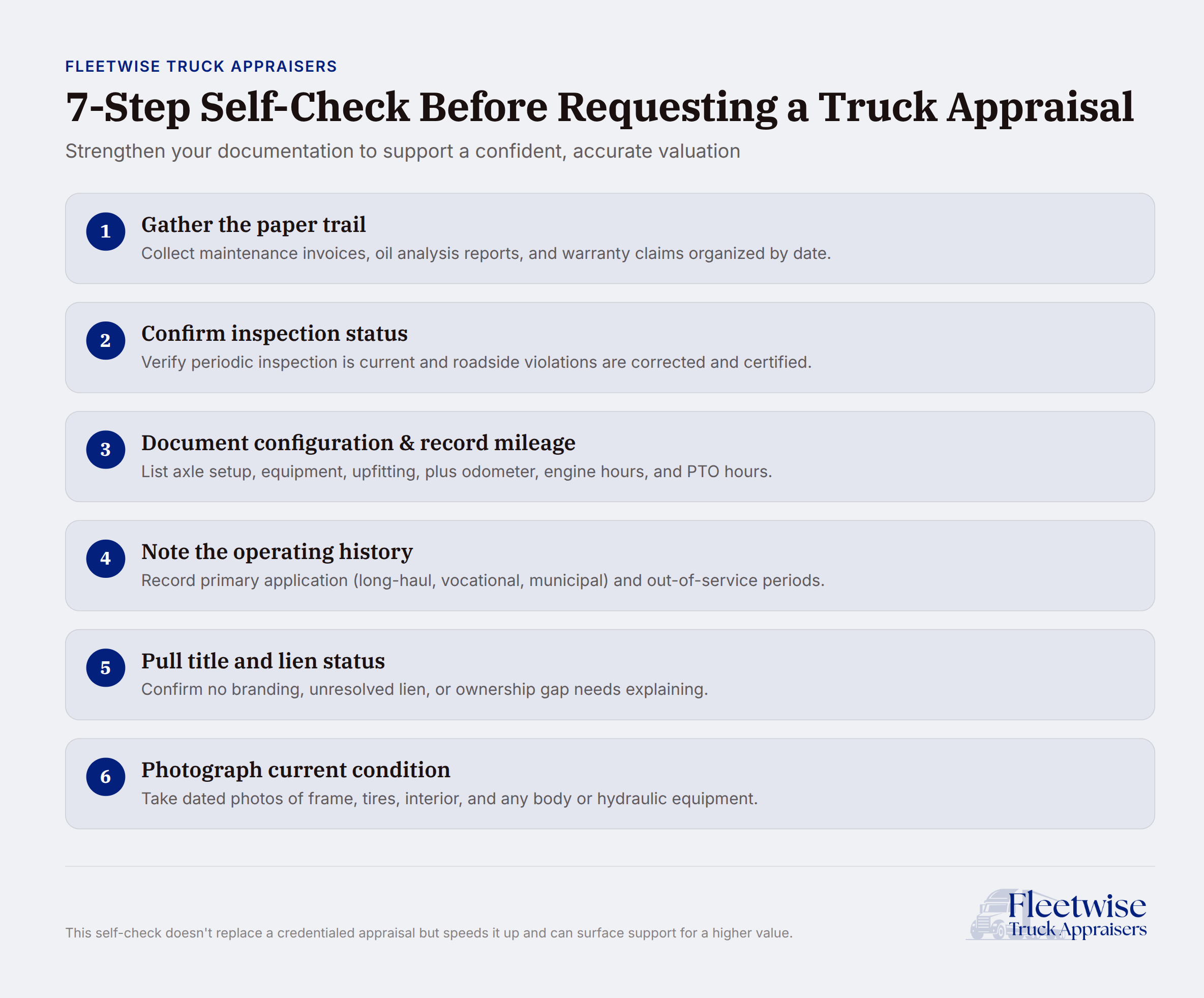
- Gather the paper trail. Pull every maintenance invoice, oil analysis report, and warranty claim you can find, organized by date.
- Confirm inspection status. Check that your periodic inspection is current and that any roadside violations have been corrected and certified.
- Document the configuration. List axle setup, sleeper or day cab, installed equipment, and any specialty upfitting with model numbers where possible.
- Record mileage and hours. Note odometer reading, engine hours, and PTO hours, and flag any inconsistency across records.
- Note the operating history. Write down the truck's primary application (long-haul, vocational, municipal) and any extended out-of-service periods.
- Pull the title and lien status. Confirm there's no branding, unresolved lien, or ownership gap that needs explaining.
- Photograph current condition. Take dated photos of the frame, tires, interior, and any body or hydraulic equipment.
This groundwork does two things. It speeds up the appraisal itself, and it often surfaces documentation that supports a higher value than you'd have gotten without it.
Why These Factors Need a Credentialed Appraiser
Online value estimators can give you a ballpark based on year, make, and model. They can't weigh a thin maintenance file against a clean compliance history, or adjust for a specialty upfit that narrows the buyer pool. That kind of judgment is why commercial truck appraisals are typically prepared by appraisers holding credentials such as the Certified Appraisers Guild of America or the American Society of Appraisers, working in accordance with USPAP (the Uniform Standards of Professional Appraisal Practice).
If you're trying to figure out where your truck stands before committing to a formal engagement, our FAQ on finding a semi-truck's value covers the free and low-cost tools owners commonly try first, and where those tools fall short for lending, insurance, or litigation purposes.
When you're ready for a defensible, USPAP-compliant number, our team can scope the assignment around your fleet size, intended use, and documentation on hand. Request an appraisal to get started.
This article is provided for general informational purposes only and does not constitute legal, tax, or financial advice. Readers should consult a qualified attorney or CPA regarding their specific circumstances.