
Blog
How Is a Truck Fleet Appraised? Book Value vs Market Comps vs Replacement Cost
Fleet owners often assume the number on their balance sheet is the real value of their trucks and trailers. This guide explains how a truck fleet is appraised using book value, market comparables, and replacement cost, and when each approach actually applies.
A mixed fleet, sleeper tractors, dry vans, reefers, and a couple of vocational bodies with custom equipment bolted on, isn't one valuation problem. It's several, running at the same time. Some units trade constantly on the used market and have deep comparable sales data behind them. Others are specialized enough that almost nothing sells that looks like them. A defensible fleet appraisal has to treat those categories differently, which is why our truck appraisal service leans on three distinct approaches rather than one formula applied to every unit on the yard.
This guide walks through how each approach works, when appraisers reach for it, and why the number on your depreciation schedule is rarely the number that ends up in the final report.
Why Book Value Isn't the Same as Your Fleet's Real Worth
Book value is an accounting figure, not an appraised value. It's the fleet's recorded historical cost minus whatever depreciation method your accountant applied, whether that's a GAAP policy for financial statements or MACRS schedules for tax purposes. Neither of those methods was designed to answer the question "what would this truck sell for today."
That gap shows up constantly in real fleets. A 12-year-old tractor that's been meticulously maintained can be fully depreciated on paper and still command a real price in the used market. A truck purchased 18 months ago can carry a high book value even after freight rates soften and resale prices drop. General commercial truck valuation resources note the same pattern: book value tracks capitalization policy and useful-life assumptions, not current market conditions reclaim.cdh.ucla.edu/default.aspx/publication/5x8mAj/Commercial_Truck_Values.pdf.
Watch out: Treating book value as your fleet's fair market value is one of the most common mistakes fleet owners make going into a sale, insurance claim, loan application, or dispute. Book value is useful for reconciling your asset register and confirming which units still exist. It is not a substitute for an appraised opinion of value, and lenders, insurers, courts, and buyers generally won't accept it as one.
The Market Approach: Sales Comparisons for Tractors and Trailers
For conventional tractors and trailers with an active resale market, the sales comparison approach usually carries the most weight. The appraiser identifies the subject truck by VIN, confirms its specifications, and then pulls comparable sales or credible market listings for units matching make, model, model year, engine, transmission, axle configuration, mileage, and installed equipment.
Each comparable then gets adjusted for the differences that actually move price:
- Mileage or engine hours relative to the subject unit
- Mechanical and cosmetic condition, including tires and aftertreatment systems
- Spec differences such as sleeper size, PTOs, or installed reefer and tank equipment
- Maintenance history, accident history, and title or lien status
- Market level: retail, wholesale, or auction, and whether the sale was closed or still an asking price
Closed transactions and auction results generally provide stronger evidence than dealer asking prices, since asking prices haven't been tested against a real buyer. That's also why generic online pricing guides fall short for commercial trucks: they weren't built to capture spec-level and condition-level differences the way they can for consumer vehicles, and industry commentary has pointed out that tools like Kelley Blue Book and NADA aren't built for the commercial segment's variability theweeklydriver.com. If you've searched for how to find the value of a semi-truck and come away with a wide range instead of a number, this is why: a credible conclusion requires adjusted comparables, not a single lookup.
Rules-of-thumb pricing benchmarks common in the trucking industry can offer a sanity check on a value range, but they're a starting point, not a substitute for adjusted comparable sales dealstream.com/industry-guides/trucking-businesses/rules-of-thumb.
For a fleet, this approach doesn't just multiply an average price by the number of trucks. Each unit or homogeneous group gets valued on its own, with consideration given to bulk-sale discounts, reconditioning costs, and whether the assignment assumes continued operation or a liquidation sale.
The Cost Approach: Replacement Cost for Specialty and Vocational Units
Not every truck on a mixed fleet trades often enough to support a market comparison. Vocational units with custom bodies, cranes, mixers, or specialty tank configurations, along with newer equipment that hasn't developed a resale track record yet, are usually better served by the cost approach.
The cost approach starts with the current cost of a replacement asset that provides equivalent utility (not necessarily an identical make and model) and then deducts three categories of depreciation:
- Physical deterioration: wear, corrosion, and mechanical aging based on the unit's actual condition.
- Functional obsolescence: the unit is less efficient or capable than current equivalents on the market.
- Economic obsolescence: outside forces, such as fuel prices, emissions regulation, or freight demand, that reduce the asset's usefulness independent of its physical condition.
Replacement cost is not the same as book value, even though both involve a form of depreciation. Book value reflects an accounting schedule set at purchase. Replacement cost less depreciation reflects what it would take to acquire equivalent utility today, adjusted for how much of that utility the existing unit has actually lost. The two numbers can move in opposite directions over the life of the same truck.
Comparing the Three Valuation Approaches
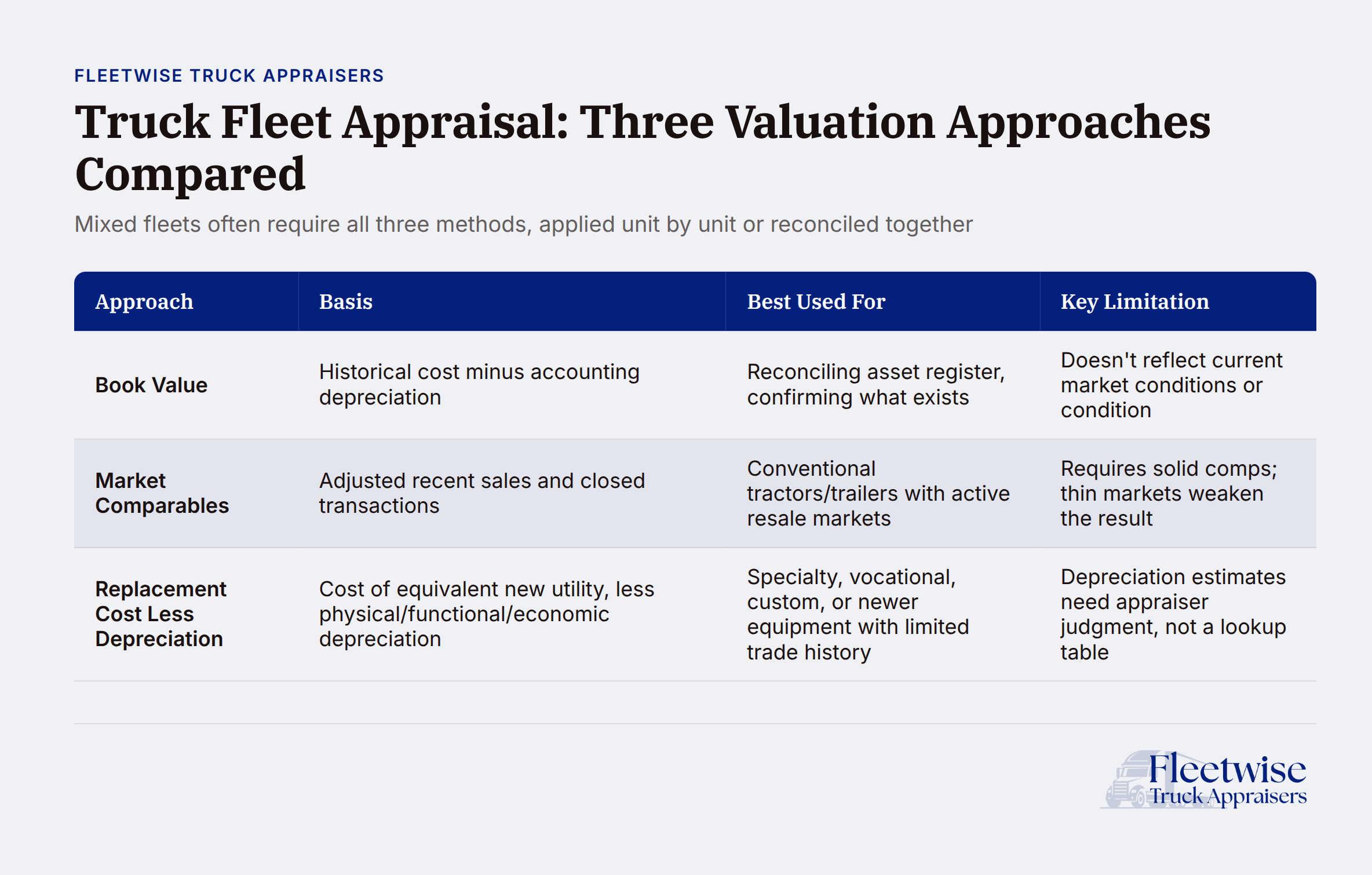
A single mixed fleet often needs all three approaches applied to different units, or reconciled against each other for the same unit. Here's how they stack up:
| Approach | Basis | Best used for | Key limitation |
|---|---|---|---|
| Book value | Historical cost minus accounting depreciation | Reconciling the asset register, confirming what exists | Does not reflect current market conditions or condition |
| Market comparables | Adjusted recent sales and closed transactions | Conventional tractors and trailers with active resale markets | Requires solid comparable data; thin markets weaken the result |
| Replacement cost less depreciation | Cost of equivalent new utility, less physical, functional, and economic depreciation | Specialty, vocational, custom, or newer equipment with limited trade history | Depreciation estimates require appraiser judgment, not a lookup table |
How Appraisers Reconcile Multiple Approaches on One Mixed Fleet
A credible fleet appraisal rarely stops at the first number that comes out of a single method. When more than one approach is available for the same unit, or when different units in the fleet call for different methods, the appraiser reconciles the results into one defensible conclusion rather than picking whichever figure is most convenient.
That reconciliation typically involves:
- Confirming the fleet inventory against VINs, titles, and lien status before assigning any value
- Valuing common tractors and trailers primarily through adjusted market comparables
- Valuing specialty or thinly traded units primarily through replacement cost less depreciation
- Weighing which approach has the strongest underlying evidence for each unit, rather than averaging results
- Applying the correct premise of value for the assignment: fair market value, orderly liquidation value, forced liquidation value, or value in continued use, since the same truck can carry different numbers under each premise
Pro tip: If your fleet includes a handful of highly specialized units alongside standard tractors and trailers, expect your report to explain, unit by unit or group by group, which approach was primary and why. That explanation is what makes the report defensible to a lender, insurer, or court, not just the final number.
What USPAP Requires Before We Even Pick an Approach
Before any approach gets selected, the assignment itself has to be defined. The Uniform Standards of Professional Appraisal Practice (USPAP), which governs personal property and equipment appraisal development and reporting under Standards 7 and 8, requires the appraiser to establish the intended use of the report, the applicable definition of value, the effective date of the appraisal, and the scope of work before analysis begins.
That sequencing matters for a fleet appraisal specifically, because the intended use often determines which approach carries the most weight. An appraisal prepared for a bank loan, an insurance claim, a divorce settlement, or a partnership buyout may call for a different value definition even on the identical fleet. Our appraisers hold credentials with organizations including the Certified Appraisers Guild of America (CAGA) and follow standards set by The Appraisal Foundation, and every engagement starts with that scoping conversation rather than a generic checklist.
What a Truck Fleet Appraisal Costs
Fleet appraisal fees are quoted as a fixed fee after we scope the assignment, never billed hourly. For individual truck appraisals, standard reports start at $195 and IRS-qualified reports start at $295, with typical assignments running $195 to $495 per unit depending on complexity. Highly complex assignments, including disputed valuations, litigation support, or specialized vocational equipment, can run $1,800 to $4,500 or more per unit.
On a mixed fleet, the fee scales with scope: the number of units, how many require the cost approach versus the market approach, the completeness of your maintenance and title records, and whether the report needs to meet IRS-qualified standards or a lender's or court's specific requirements. A fleet's value, high or low, doesn't change what the appraisal costs; that's driven entirely by how much work the assignment requires.
This article is provided for general informational purposes only and does not constitute legal, tax, or financial advice. Readers should consult a qualified attorney or CPA regarding their specific circumstances.
If you're preparing to sell, insure, finance, or settle a dispute involving a mixed truck fleet, getting the approach right from the start saves time and protects the number you end up relying on. Request an appraisal and we'll scope your fleet, tell you which approaches apply, and quote a fixed fee before any work begins.