
Blog
Truck Appraisal for Estate Purposes: What Fair Market Value Means on the Date of Death
A truck appraisal for estate purposes turns on fair market value as of the date of death, not a later sale price or trade-in quote. This guide explains the IRS standard, the alternate valuation election, and how to value a fleet truck by truck instead of guessing at a bulk discount.
When someone dies owning a truck, whether it's a single pickup, a flatbed used in a small hauling business, or a multi-unit commercial fleet, that vehicle becomes part of the taxable estate the same as a house or a brokerage account. Figuring out what it was worth on the date of death isn't a guess, and it isn't a trade-in quote from a dealer lot. It's a specific legal standard with its own documentation requirements. Our truck appraisal service walks estates and probate attorneys through exactly this process: establishing a defensible fair market value for a decedent's truck or fleet as of the date of death, documenting it the way the IRS expects, and handling the cases where a fleet needs to be broken down unit by unit rather than discounted as a block.
What Fair Market Value Means for a Truck in an Estate
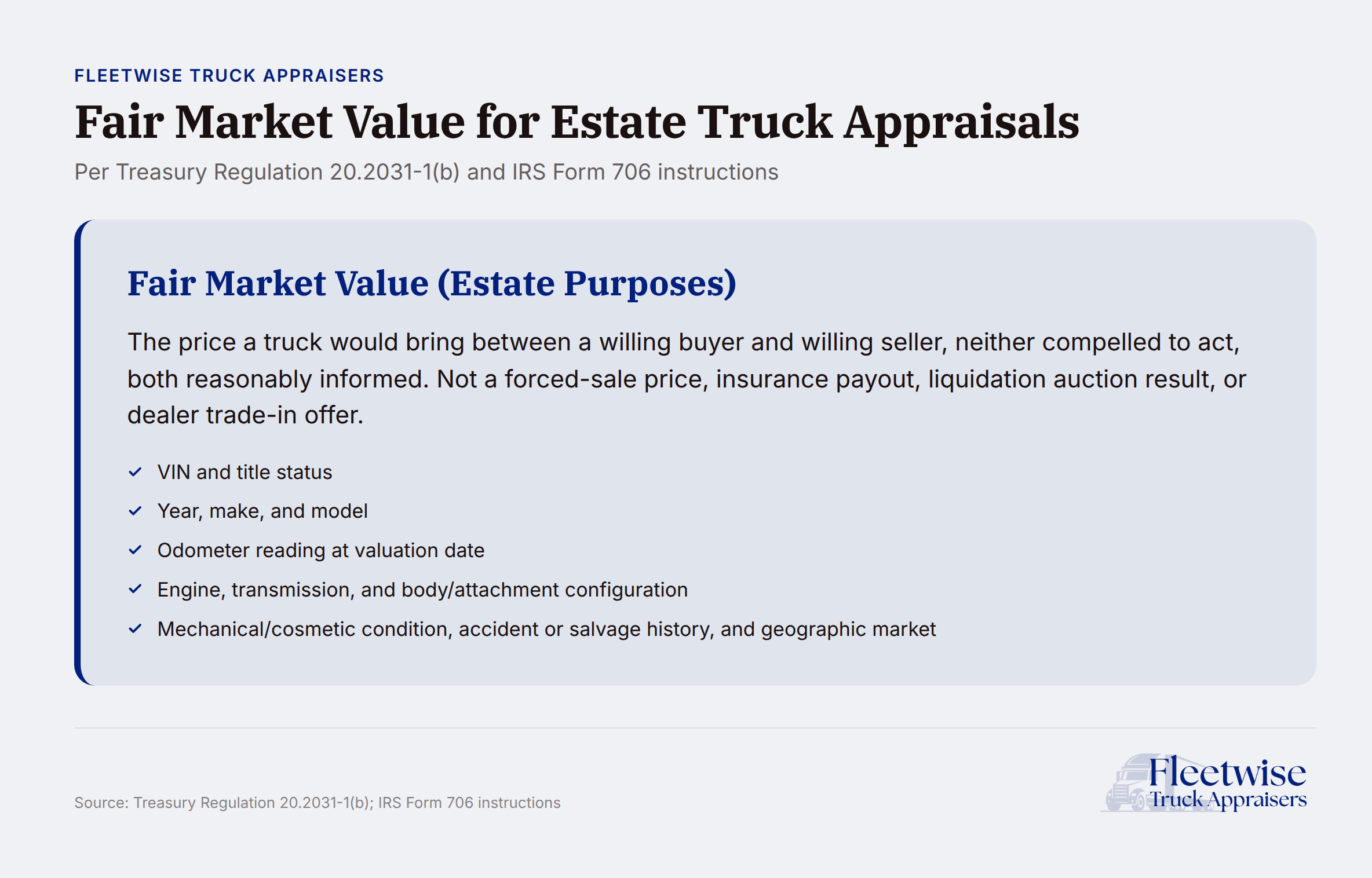
Fair market value, for estate purposes, is the price a truck would bring in a sale between a willing buyer and a willing seller, neither one forced to transact, and both reasonably informed about the vehicle and its market. This standard comes from Treasury Regulation 20.2031-1(b), and it governs every item in a decedent's gross estate, trucks included, per the IRS Form 706 instructions.
"Fair market value is the price at which property would change hands between a willing buyer and a willing seller, neither being under any compulsion to buy or sell, and both having reasonable knowledge of relevant facts. Fair market value is not to be determined by a forced sale price." - Treasury Regulation 20.2031-1(b)
That last sentence matters more than it looks. A forced-sale price, an insurance payout, an auction result from a liquidation event, or a dealer's lowball trade-in offer are not fair market value. They may be evidence, but none of them are the standard the IRS applies. The appraiser's job is to establish what the truck would actually sell for in the market where trucks like it are ordinarily sold, with a reasonable amount of time for the transaction to occur.
For a truck specifically, that analysis has to account for the vehicle's year, make, and model, its VIN and title status, odometer reading, engine and transmission specifications, any specialized body or attachments, mechanical and cosmetic condition, accident or salvage history, and the relevant geographic market. Mileage and condition at the precise valuation date drive the number more than almost anything else, which is a big part of why the factors that move a truck's appraised value up or down need to be documented, not estimated.
Why the Date of Death Sets the Valuation Standard
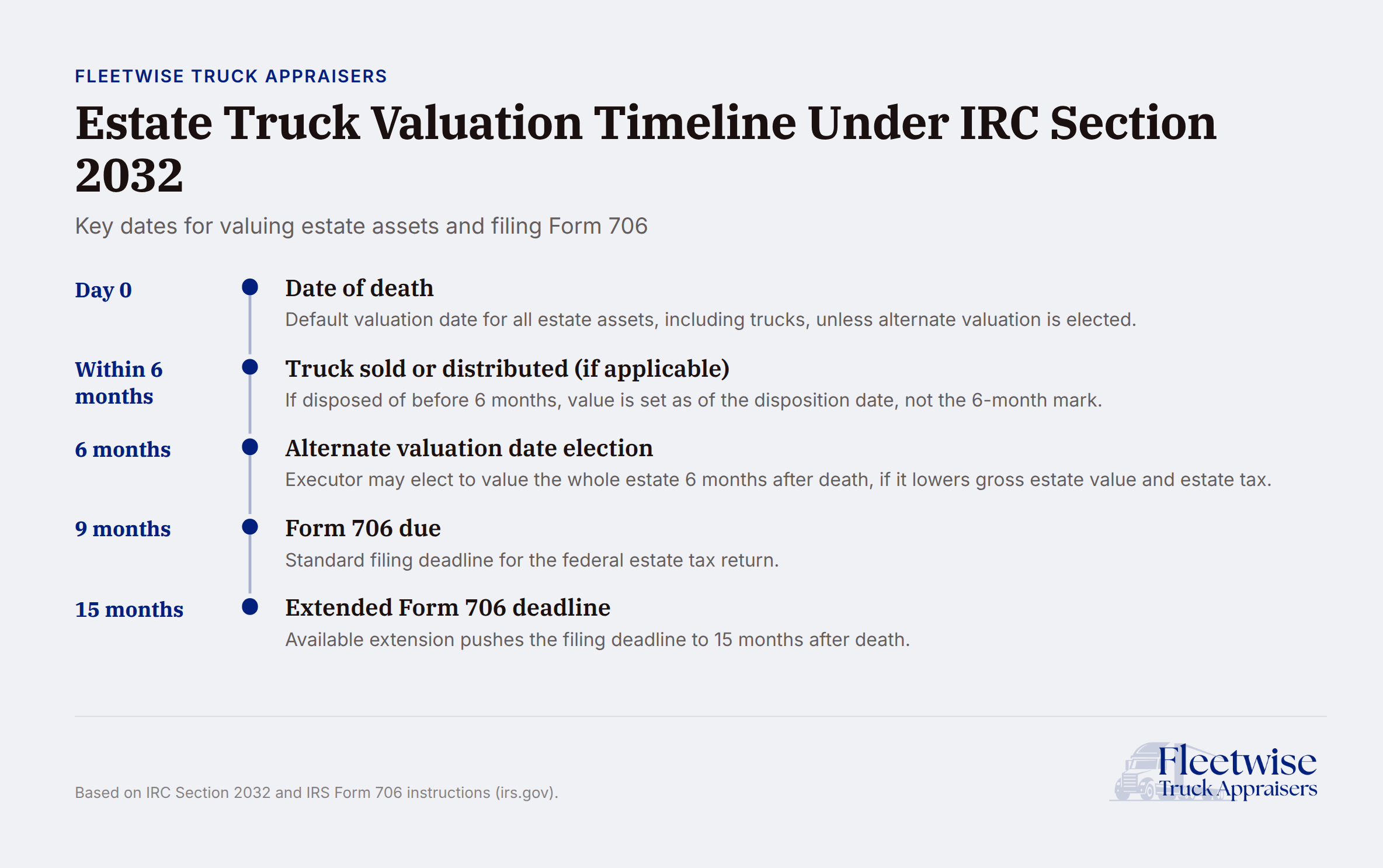
Unless the executor makes a specific election, a truck's value for estate purposes is fixed as of the decedent's date of death, not whenever the estate gets around to selling it. A truck sold six months after death at a lower price doesn't automatically prove it was worth less on the valuation date; mileage kept accumulating, parts wore down, and the market for that type of truck may have shifted in the meantime.
This cuts both ways. If an executor tries to use a later, lower sale price as evidence of date-of-death value, the appraiser has to account for what changed between the two dates: added mileage, deferred maintenance, repairs performed, or swings in demand for that class of vehicle, whether it's construction, agricultural, or long-haul freight equipment. A sale completed within a reasonable time of the valuation date, with no substantial change in market conditions, carries real evidentiary weight. A sale six or eight months later, after the truck has been driven hard and the market has moved, carries much less.
The stakes here aren't abstract. For a decedent who died in 2026, the IRS lists a federal estate tax filing threshold of $15,000,000, calculated across the gross estate, adjusted taxable gifts, and the applicable exemption, according to the IRS's current estate and gift tax guidance. A truck's value gets added into that gross estate calculation along with everything else the decedent owned. Even when an estate falls well under the threshold, a documented appraisal still matters for probate accounting, equalizing distributions among heirs, and establishing the beneficiary's basis in the inherited vehicle.
The Alternate Valuation Date Election Under IRC Section 2032
An executor can elect to value the entire estate six months after the date of death instead of on the date of death itself, under Internal Revenue Code Section 2032. This is not a truck-by-truck choice; it's an election that applies to the whole estate, and it's only available when it actually reduces both the gross estate value and the resulting estate tax liability, as described in the IRS Form 706 instructions.
If the truck is sold, distributed to an heir, or otherwise disposed of within that six-month window, its value is generally set as of the date of that disposition rather than the full six-month mark. That makes timing critical: an appraiser working on an alternate-valuation estate needs to know exactly when a given truck left the estate, because that date, not an arbitrary six-month anniversary, becomes the effective valuation date for that asset.
All of this has to come together before Form 706 is due, which is generally nine months after the date of death, with an available extension that pushes the deadline to fifteen months. An appraisal commissioned at the last minute, after the alternate-valuation window has already closed or the filing deadline is days away, leaves no room to correct course if a comparable sale needs more research or a title issue surfaces.
Should a Fleet Be Valued Truck by Truck or as a Group?
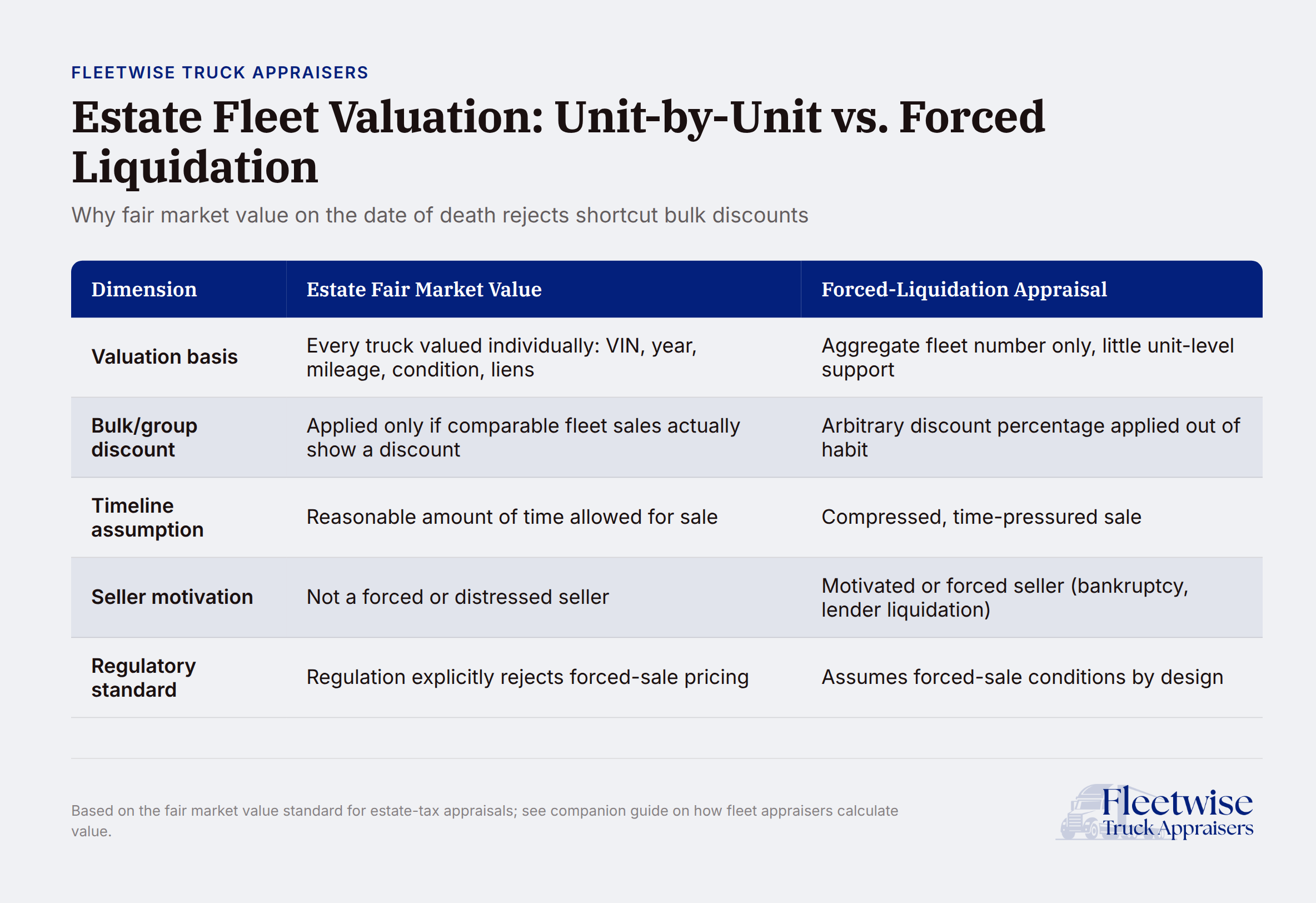
Individual, unit-level inventory and valuation is the foundation of any defensible fleet appraisal, estate or otherwise. Every truck in the fleet gets its own line: VIN, year, make, model, mileage, configuration, equipment, condition, and any liens or title restrictions attached to it. There's no shortcut around this step. An estate, a probate court, or the IRS can ask for support behind any single unit's value, and a report that only shows an aggregate fleet number has nothing to point to.
Once every unit is individually valued, a bulk or fleet-level adjustment can sometimes be appropriate, but only when it's supported by actual market evidence, not an arbitrary discount percentage pulled out of habit. If comparable multi-unit fleet sales in that market genuinely transact at a discount to the sum of individual retail values, because buyers want volume pricing or because a large same-type fleet floods a thin local market, that evidence can support an adjustment. Absent that evidence, the individually valued totals stand as the fleet's fair market value.
This is also where the estate-tax premise diverges sharply from a liquidation premise. A bankruptcy sale, a lender's forced-liquidation appraisal, or an auction held under time pressure assumes a compressed timeline and a motivated seller, both of which push values down. Fair market value for estate purposes explicitly rejects that premise: the regulation says the value is not to be determined by a forced-sale price, and it assumes a reasonable amount of time is available for the transaction to occur. A fleet appraiser who defaults to a liquidation-style bulk discount because it's faster to calculate is applying the wrong standard to the wrong purpose. Our guide to how fleet appraisers calculate value walks through the sales-comparison, cost, and reconciliation steps in more depth.
Key takeaway: build the appraisal from individual units up, and only apply a group-level adjustment when a comparable fleet transaction actually supports one.
How Estate Valuation Differs From a Divorce or Litigation Appraisal
An estate and probate appraisal is not interchangeable with a divorce valuation or a litigation appraisal, even when the same truck is the subject of both. The definition of value and the effective date both change with the purpose.
- Estate and probate: fair market value as of the date of death, or the alternate valuation date if properly elected, under the standard set out in Treasury Regulation 20.2031-1(b).
- Divorce and equitable distribution: typically fair market value as of the date of filing, separation, or a date set by the court, which varies by state law rather than a single federal standard.
- Litigation and insurance disputes: the relevant date is often tied to the date of loss, the date of an accident, or another event specified by the claim or the court, and the premise of value can differ depending on what's being litigated.
This is why the intended use has to be nailed down before an appraisal starts, not after. A report prepared for one purpose, using the wrong effective date or definition of value, generally cannot simply be repurposed for another. Appraisers working across these contexts hold credentials from organizations including the ASA, ISA, and AAA, and prepare reports in accordance with the Uniform Standards of Professional Appraisal Practice regardless of which purpose the engagement serves. What changes is which standard of value and which date governs the number.
What a Truck Appraisal Costs for Estate and Probate Use
A truck appraisal is quoted as a fixed fee after we scope the assignment, never billed hourly. For a standard report, our published pricing starts at $195, and an IRS-qualified report, the version typically required for estate tax filings, starts at $295. Most single-truck estate appraisals run $195 to $495, with higher-complexity engagements, such as a specialized or heavily modified commercial truck, a multi-unit fleet, or a case requiring extensive comparable research, ranging from $1,800 to $4,500 or more.
The fee is driven by the scope of the assignment: how many trucks are involved, how complete the existing records and title documentation are, whether the report needs to meet IRS-qualified standards for Form 706, and how much comparable-sale research the valuation date requires. A decedent's market value, condition, or mileage affects the concluded value, not what the appraisal costs to prepare.
Getting the Valuation Date Right the First Time
An estate's truck or fleet only gets valued once with the stakes that matter: for the IRS filing, for the probate court, and for the basis every heir will carry forward. Getting the effective date, the definition of value, and the unit-by-unit documentation right from the start avoids having to redo the work under deadline pressure. If you're an executor, attorney, or fiduciary working through a decedent's truck or fleet, our team can scope the assignment and provide a fixed-fee quote through our request an appraisal page.
This article is provided for general informational purposes only and does not constitute legal, tax, or financial advice. Readers should consult a qualified attorney or CPA regarding their specific circumstances.