
Blog
Truck Insurance Total Loss Appraisal: How Insurers Decide Repair vs Replace
A truck insurance total loss appraisal compares repair cost and salvage value against the truck's pre-loss value, and the basis used (actual cash value, agreed value, or stated value) determines what you actually get paid. This guide shows fleet owners how that math works and what to do when the insurer's number looks wrong.
When a commercial truck is damaged in an accident, the insurer's first question is not "what will it cost to fix this?" It's whether fixing it even makes financial sense. Understanding how that total loss determination gets made, and which valuation basis your policy actually uses, is the difference between a fair settlement and a fight. This guide walks through the math, the three valuation bases fleet owners actually deal with, and why upfitted work trucks get shortchanged more often than factory-stock ones.
How a Total Loss Determination Works
An insurer typically declares a commercial truck a total loss when the estimated repair cost, plus the truck's salvage value, equals or exceeds its pre-damage value. That pre-damage value is called actual cash value, agreed value, or stated value depending on how your policy is written, and the specific threshold and formula used varies by state and by the insurer's claims practices rather than a single nationwide rule.
The basic logic looks like this:
- Repair cost estimate: body, cab, frame, powertrain, and any safety-system repairs, including supplements once hidden damage is found.
- Salvage value: what the damaged truck or its components would bring if sold rather than repaired.
- Pre-loss value: the truck's value immediately before the accident, under whichever basis your policy specifies.
If repair cost plus salvage value exceeds the pre-loss value, the truck gets totaled. A truck can be mechanically repairable and still be declared a total loss on economic grounds, particularly when frame damage, a branded title, or specialized body work pushes the repair bill high enough.
For fleet owners managing multiple units, our truck appraisal services build defensible pre-loss and post-loss values using comparable-unit data rather than a single lookup figure, which matters most when a truck carries equipment a generic valuation tool doesn't price correctly.
The Three Valuation Bases in Commercial Auto Policies
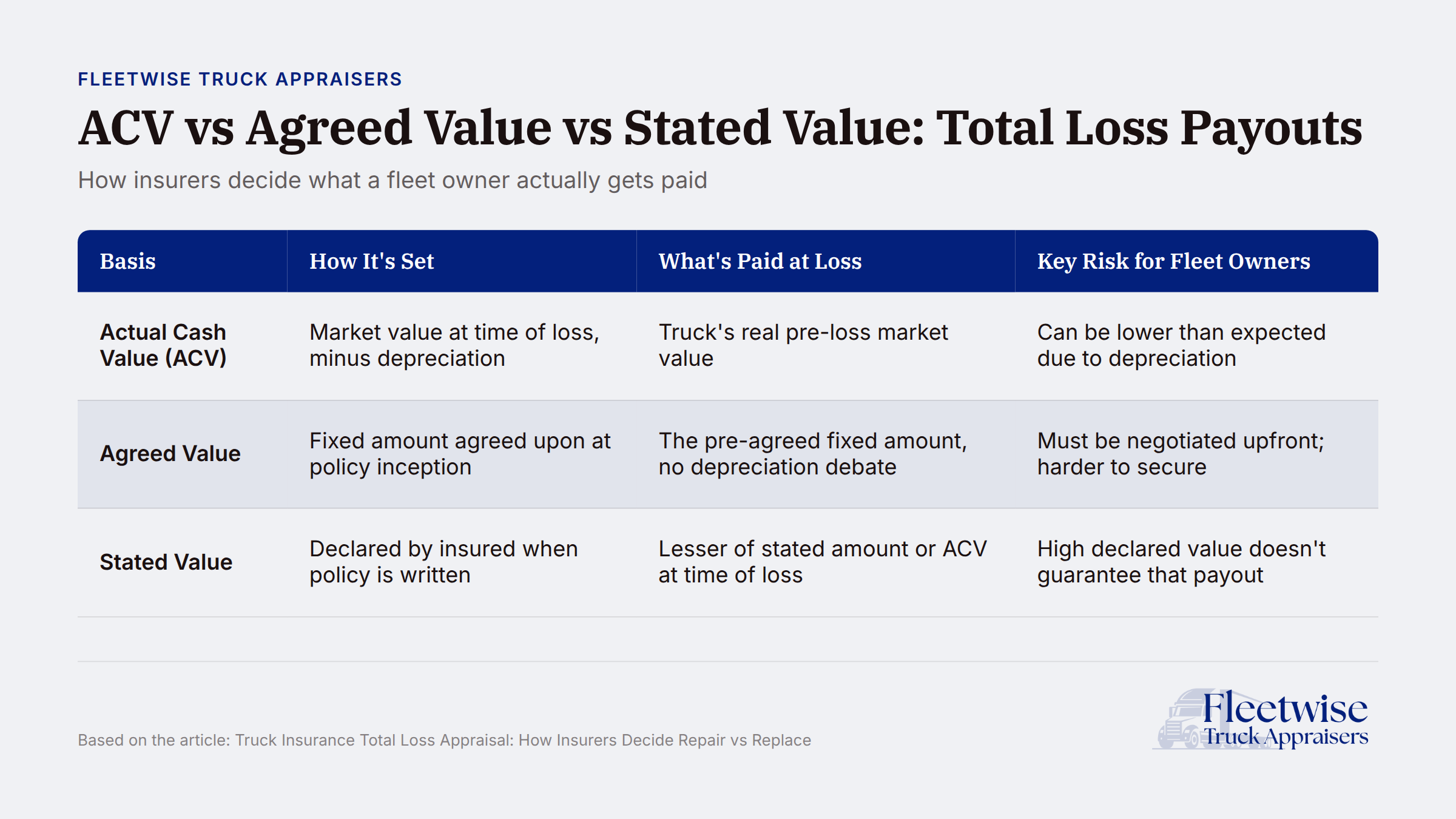
Which number the insurer pays depends entirely on which valuation basis your policy uses. These are three distinct concepts, and confusing them is the single most common source of disputed truck claims.
Actual Cash Value (ACV)
Actual cash value is the truck's depreciated fair market value immediately before the loss. It is generally calculated as replacement cost new less depreciation, or by referencing comparable sales of similar completed units (same year, make, configuration, mileage, and condition). ACV is the default basis for most commercial auto physical damage coverage, and it's the one most likely to produce a number lower than what an owner expects, especially on a truck that was recently upgraded or well maintained.
Agreed Value
Agreed value is a figure negotiated and accepted by both insurer and insured before the policy takes effect. If the truck becomes a covered total loss, that agreed figure is what gets paid, subject to the deductible and other policy conditions, without a later argument over depreciation. Agreed value coverage is common on specialized or hard-to-comp units precisely because it removes the ACV guessing game at claim time.
Stated Value (Stated Amount)
Stated value is a figure the insured declares when the policy is written, often to set a premium basis. This is where fleet owners get tripped up: insurers typically pay the lesser of the stated amount or the truck's actual cash value at the time of loss, not the full stated figure automatically. A high declared value on the declarations page does not guarantee that payout if the truck's real pre-loss market value turns out lower. Reading the stated value language in your policy before a loss happens, not after, is the only way to avoid this surprise.
Why Upfitted Trucks Are Hard to Value (and Often Underinsured)
A box truck with a liftgate, a service truck with a crane, or a reefer unit on a straight chassis is really two assets bolted together: the factory cab and chassis, and the aftermarket equipment mounted on it. VIN-based valuation tools are built around factory data, so they routinely price only the bare chassis and cab and miss the upfit entirely unless it has been separately disclosed, scheduled, or documented.
How your policy treats that upfit generally falls into one of three buckets:
- Included in the insured vehicle: the equipment is covered as part of the truck's value if it was disclosed when the policy was written.
- Covered under a scheduled-equipment or custom-parts endorsement: a separate line item with its own stated value, which protects the upfit independently of the chassis valuation.
- Excluded or subject to a low default limit: if the equipment was never disclosed, many policies cap or exclude recovery for it, leaving the owner to absorb the gap.
Watch out: Fleet owners who add a liftgate, crane, or refrigeration unit after the policy is written and never call their agent to update the schedule are the ones most likely to see a total loss payout that covers the chassis and nothing else.
Worked Example: Valuing a Box Truck With a Custom Liftgate
Example: Consider a 2021 box truck with a factory cab and chassis plus an aftermarket 16-foot box body and a hydraulic liftgate installed by an upfitter after purchase. The insurer's initial total loss offer, based on a VIN lookup, comes in at $38,000, a figure that reflects comparable bare cab-and-chassis sales in the region.
An independent appraisal approaches the truck as two priced components rather than one VIN lookup:
- Cab and chassis comparable value: $34,000, based on recent sales of similar mileage and condition units.
- Box body and liftgate installed value: $11,500, based on the original upfit invoice, current dealer quotes for an equivalent install, and documented condition at time of loss.
- Combined comparable-unit value: $45,500 before adjustments for mileage, maintenance history, and market condition.
That $7,500 gap between the insurer's initial number and the comparable-unit valuation is the upfit the lookup tool never priced. These figures are illustrative only and not a quote for any real claim, but the pattern they show up repeatedly in disputed commercial truck claims is real.
Documentation That Strengthens an Upfitted Truck's Valuation
The strength of a total loss dispute usually comes down to paperwork. Fleet owners who keep the following on hand are in a far stronger position when a claim gets contested:
- Original purchase and installation invoices for the chassis and for any aftermarket equipment
- Equipment specifications and serial numbers for liftgates, cranes, reefer units, or service bodies
- Photographs of the mounted equipment taken before the loss, ideally as part of routine fleet records
- Maintenance and service records showing the truck's upkeep history
- Current dealer or installer quotes for replacing the equivalent equipment new
- The policy declarations page and any scheduled-equipment or custom-parts endorsement
Assembling this before a loss happens, not scrambling for it after an adjuster's first offer, is the single biggest factor in whether a dispute resolves quickly or drags on for months.
When You Disagree: The Appraisal Clause and Independent Valuation
Most commercial auto and physical damage policies include an appraisal clause for disputes over the amount of loss. This clause typically works as a defined sequence rather than an open-ended negotiation.
- Invoke the appraisal clause. Either party can demand appraisal in writing once there's a genuine dispute over the dollar amount, not over coverage or liability.
- Each side names its own appraiser. The policyholder and the insurer each select a competent appraiser to independently value the loss.
- The appraisers attempt to agree. If their figures align or come close, that becomes the settlement amount.
- An umpire resolves disagreement. If the two appraisers can't agree, they select a neutral umpire, and any two of the three participants' decision sets the final amount.
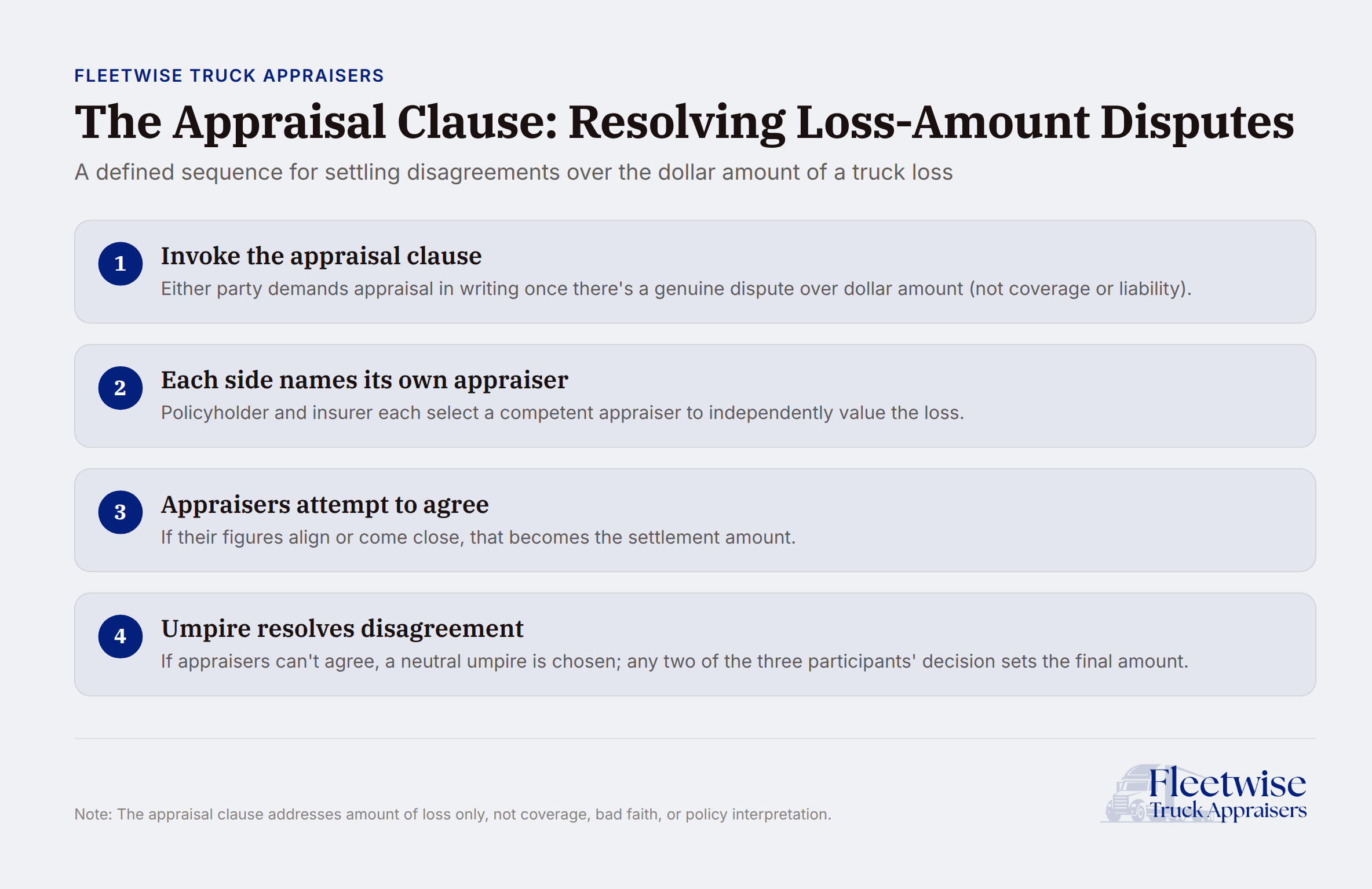
It's worth being precise about what this process does and doesn't do. The appraisal clause addresses the amount of loss, not whether the claim is covered, whether the insurer acted in bad faith, or how the policy should be interpreted. Our appraisers prepare USPAP-compliant independent valuations for exactly this step, built from comparable-unit data and the documentation above, with no guarantee of a specific outcome or settlement figure. For a straightforward single-truck engagement, fees are quoted as a fixed fee once we've scoped the assignment; for most trucks that typically falls in the $195 to $495 range, with more complex upfitted or disputed units running higher. If you're assessing what factors move a truck's number up or down before a dispute even starts, our guide on what affects a truck's appraised value covers the variables adjusters weigh most.
The Broad Evidence Rule
In many jurisdictions, actual cash value determinations are governed by what's known as the broad evidence rule: when a dispute over value reaches a court or a formal appraisal, the decision-maker can weigh any relevant evidence of value, not just the output of a single pricing guide or VIN-lookup tool. That matters directly for upfitted trucks, because it means invoices, installer quotes, comparable sales, and condition photographs are all legitimate evidence, not just a supplement to whatever number the insurer's software generated first. Fleet owners who understand this rule going in are far less likely to accept a first offer that only reflects the bare chassis.
Protecting Your Fleet's Next Claim
A commercial truck total loss claim is really a question about which number gets used, not just how much damage occurred. Knowing whether your policy runs on actual cash value, agreed value, or stated value, and keeping upfit documentation current before a loss happens, puts you in a far stronger position when the adjuster's first number doesn't match reality. For a deeper look at how fleet valuations differ from single-unit claims, see our guide on how truck fleet appraisers calculate value. If your insurer's total loss offer doesn't reflect your truck's actual configuration, our team can prepare an independent valuation built for the appraisal process described above.
This article is provided for general informational purposes only and does not constitute legal or insurance advice. Readers should consult their policy language and a qualified attorney or insurance professional regarding their specific claim.